Abstract of the Lecture
Professor Robert N. Spengler reviewed the research history of prehistory human migration in Central Asia. He challenged the long-standing narrative of nomadic warriors migrating from the steppes to conquer neighboring agricultural populations, arguing that the archaeological narrative of prehistory nomadic migrations in Central Asia is often the result of political propaganda. He points out that recent scientific studies, especially ancient genomic research, revealed that the expansion of the Yamnaya population occurred not through mass military migrations, but through gene admixture and population expansion waves. Spengler emphasizes the need to rethink our understanding of Central Asian prehistory, recognizing it as an agriculture-dominated region rather than a purely nomadic one. He calls for the application of new scientific data and methods in future research and encourages continuing in-depth studies in this field.
Invited Speaker:
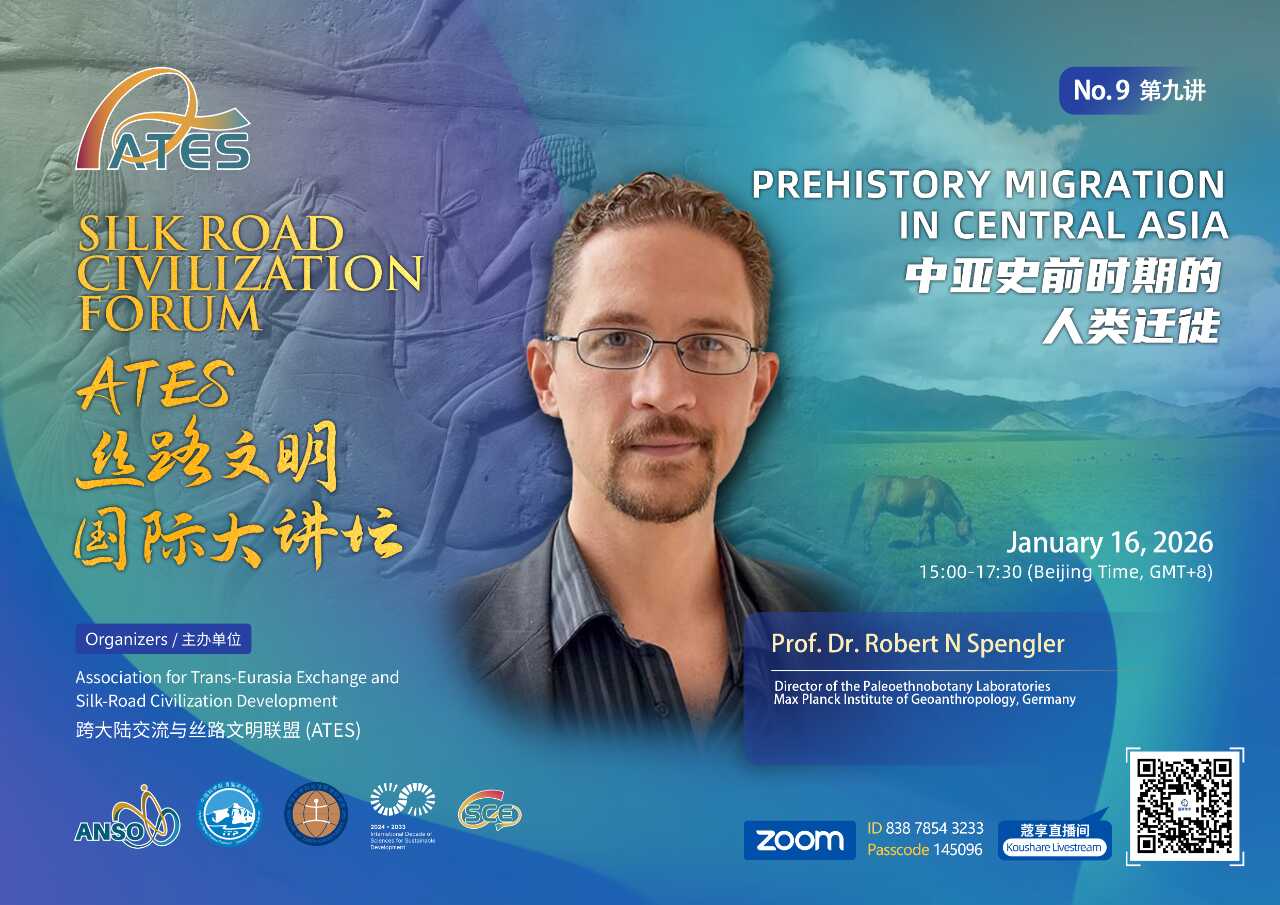
Prof. Dr. Robert N Spengler
Domestication and Anthropogenic Evolution (DAE) Research Group
Fruits of Eurasia: Domestication and Dispersal (FEDD) Research Group
Mongolian Archaeological Project: Surveying the Steppe (MAPSS)
Director of the Paleoethnobotany Laboratories, Max Planck Institute of Geoanthropology, Germany
Time:
15:00-17:30 (Beijing Time), 16th January, 2026
8:00 am-10:30 am (CET), 16th January, 2026
Zoom ID: 838 7854 3233
Password: 145096
Koushare Live Streaming:
https://www.koushare.com/live/details/49547
Biography of the Speaker
Robert N Spengler is currently the director of the Paleoethnobotany Laboratories at the Max Planck Institute for the Science of Human History (Max-Planck-Institut für Menschheitsgeschichte) in Jena. He is studying the paleoeconomy and ecology of Central Asia from the third millennium B.C. onward and has ongoing research projects in Kazakhstan, Uzbekistan, Turkmenistan, China, and Mongolia. While he has used several methods in the archaeobotanical sciences, he primarily analyzes macrobotanical remains. Through this research he has shown that farming was an important part of the economy across eastern Central Asia for at least four millennia and that many important crops spread through this region in prehistory. Through his archaeobotanical studies, he is helping to fill in the last major gaps in the global map of agricultural spread, and showing how important the Silk Road was in the spread of specific crops and technologies. In addition, his data feed into a broader understanding of human adaptations, social development, and the linked nature between agricultural intensification and social complexity.